Ecumenical Councils
Quotes On The Importance Of Eucharistic Adoration
www.eucharisticadorationquotes.org
Ecumenical Councils
Quotes On The Importance Of Eucharistic Adoration
Page Find & Search Options
📜 Choose a Council:
— OR —
(Use these tools to jump to a council or search words/titles on this page.)
Council Jump List
Councils are listed below in chronological order; use the jump list above to move between them.
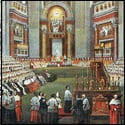
Fourth Lateran Council (1215)
The Fourth Lateran Council, convoked by Pope Innocent III, defined the doctrine of transubstantiation and the Real Presence of Christ in the Eucharist — the doctrinal foundation on which Eucharistic adoration rests.
The Fourth Lateran Council, convoked by Pope Innocent III, defined the doctrine of transubstantiation and the Real Presence of Christ in the Eucharist — the doctrinal foundation on which Eucharistic adoration rests.
Nov. 11, 1215 - Constitution I, Canon 1 (Confession of Faith)
(Source: Papal Encyclicals Online — www.papalencyclicals.net)
"There is indeed one universal church of the faithful, outside of which nobody at all is saved, in which Jesus Christ is both priest and sacrifice. His body and blood are truly contained in the sacrament of the altar under the forms of bread and wine, the bread and wine having been changed in substance, by God's power, into his body and blood, so that in order to achieve this mystery of unity we receive from God what he received from us."
Nov. 11, 1215 - Constitution I, Canon 20 (Chrism and the Eucharist to be kept under lock and key)
(Source: Papal Encyclicals Online — www.papalencyclicals.net)
"We decree that the chrism and the eucharist are to be kept locked away in a safe place in all churches, so that no audacious hand can reach them to do anything horrible or impious. If he who is responsible for their safe-keeping leaves them around carelessly, let him be suspended from office for three months; if anything unspeakable happens on account of his carelessness, let him be subject to graver punishment."
(Source: Papal Encyclicals Online — www.papalencyclicals.net)
"There is indeed one universal church of the faithful, outside of which nobody at all is saved, in which Jesus Christ is both priest and sacrifice. His body and blood are truly contained in the sacrament of the altar under the forms of bread and wine, the bread and wine having been changed in substance, by God's power, into his body and blood, so that in order to achieve this mystery of unity we receive from God what he received from us."
Nov. 11, 1215 - Constitution I, Canon 20 (Chrism and the Eucharist to be kept under lock and key)
(Source: Papal Encyclicals Online — www.papalencyclicals.net)
"We decree that the chrism and the eucharist are to be kept locked away in a safe place in all churches, so that no audacious hand can reach them to do anything horrible or impious. If he who is responsible for their safe-keeping leaves them around carelessly, let him be suspended from office for three months; if anything unspeakable happens on account of his carelessness, let him be subject to graver punishment."
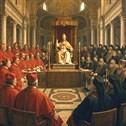
Council of Florence (1431 to 1445)
At the Council of Florence, the decree of union with the Armenians (Session 8, November 22, 1439) set forth Catholic teaching on the seven sacraments, including the Real Presence and sacrificial character of the Eucharist.
At the Council of Florence, the decree of union with the Armenians (Session 8, November 22, 1439) set forth Catholic teaching on the seven sacraments, including the Real Presence and sacrificial character of the Eucharist.
Nov. 22, 1439 - Decree of Union with the Armenians (On the Sacrament of the Eucharist)
(Source: Papal Encyclicals Online — www.papalencyclicals.net)
"The third is the sacrament of the Eucharist. Its matter is wheat bread and wine from the vine... The form of this sacrament are the words of the Saviour with which he effected this sacrament. A priest speaking in the person of Christ effects this sacrament. For, in virtue of those words, the substance of bread is changed into the body of Christ and the substance of wine into his blood. In such wise, however, that the whole Christ is contained both under the form of bread and under the form of wine, under any part of the consecrated host as well as after division of the consecrated wine, there is the whole Christ. The effect of this sacrament, which is produced in the soul of one who receives it worthily, is the union of him or her with Christ."
(Source: Papal Encyclicals Online — www.papalencyclicals.net)
"The third is the sacrament of the Eucharist. Its matter is wheat bread and wine from the vine... The form of this sacrament are the words of the Saviour with which he effected this sacrament. A priest speaking in the person of Christ effects this sacrament. For, in virtue of those words, the substance of bread is changed into the body of Christ and the substance of wine into his blood. In such wise, however, that the whole Christ is contained both under the form of bread and under the form of wine, under any part of the consecrated host as well as after division of the consecrated wine, there is the whole Christ. The effect of this sacrament, which is produced in the soul of one who receives it worthily, is the union of him or her with Christ."

Council of Trent (1545 to 1563)
The Council of Trent included the most significant development of Eucharistic theological doctrine since the apostolic age. Its work became the foundation for Eucharistic dogmatic and devotional progress ever since.
The Council of Trent included the most significant development of Eucharistic theological doctrine since the apostolic age. Its work became the foundation for Eucharistic dogmatic and devotional progress ever since.
Oct. 11, 1551 - Session XIII, Decree on the Sacrament of the Eucharist
(Source: Papal Encyclicals Online — www.papalencyclicals.net)
Chapter V. "There is, therefore, no room for doubt that all the faithful of Christ may, in accordance with a custom always received in the Catholic Church, give to this most holy sacrament in veneration the worship of latria, which is due to the true God. Neither is it to be less adored for the reason that it was instituted by Christ the Lord in order to be received. For we believe that in it the same God is present of whom the eternal Father, when introducing Him into the world, says: And let all the angels of God adore him; whom the Magi, falling down, adored; who, finally, as the Scriptures testify, was adored by the Apostles in Galilee."
The holy Synod declares, moreover, that very piously and religiously was this custom introduced into the Church, that this sublime and venerable sacrament should be, with special veneration and solemnity, celebrated every year on a certain day, and that a festival; and that it should be borne reverently and with honour in processions through the streets and public places. For it is most just that there be certain appointed holy days, whereon all Christians may, with a special and unusual demonstration, testify that their minds are grateful and thankful to their common Lord and Redeemer for so ineffable and truly divine a benefit, whereby the victory and triumph of His death are represented.
Canon 6. "If anyone says that in the holy sacrament of the Eucharist, Christ, the only begotten Son of God, is not to be adored with the worship of latria, also outwardly manifested, and is consequently neither to be venerated with a special festive solemnity, nor to be solemnly borne about in procession according to the laudable and universal rite and custom of holy Church, or is not to be set publicly before the people to be adored and that the adorers thereof are idolaters, let him be anathema."
The Catechism of Trent (the Fourth Petition of the Lord's Prayer) — "The Eucharist is called our bread, because it is the food of the faithful only, that is to say, of those who, uniting charity to faith, wash away the defilement of their sins in the Sacrament of Penance, and mindful that they are the children of God, receive and adore this divine Sacrament with all possible holiness and veneration."
(Source: Papal Encyclicals Online — www.papalencyclicals.net)
Chapter V. "There is, therefore, no room for doubt that all the faithful of Christ may, in accordance with a custom always received in the Catholic Church, give to this most holy sacrament in veneration the worship of latria, which is due to the true God. Neither is it to be less adored for the reason that it was instituted by Christ the Lord in order to be received. For we believe that in it the same God is present of whom the eternal Father, when introducing Him into the world, says: And let all the angels of God adore him; whom the Magi, falling down, adored; who, finally, as the Scriptures testify, was adored by the Apostles in Galilee."
The holy Synod declares, moreover, that very piously and religiously was this custom introduced into the Church, that this sublime and venerable sacrament should be, with special veneration and solemnity, celebrated every year on a certain day, and that a festival; and that it should be borne reverently and with honour in processions through the streets and public places. For it is most just that there be certain appointed holy days, whereon all Christians may, with a special and unusual demonstration, testify that their minds are grateful and thankful to their common Lord and Redeemer for so ineffable and truly divine a benefit, whereby the victory and triumph of His death are represented.
Canon 6. "If anyone says that in the holy sacrament of the Eucharist, Christ, the only begotten Son of God, is not to be adored with the worship of latria, also outwardly manifested, and is consequently neither to be venerated with a special festive solemnity, nor to be solemnly borne about in procession according to the laudable and universal rite and custom of holy Church, or is not to be set publicly before the people to be adored and that the adorers thereof are idolaters, let him be anathema."
The Catechism of Trent (the Fourth Petition of the Lord's Prayer) — "The Eucharist is called our bread, because it is the food of the faithful only, that is to say, of those who, uniting charity to faith, wash away the defilement of their sins in the Sacrament of Penance, and mindful that they are the children of God, receive and adore this divine Sacrament with all possible holiness and veneration."

Second Vatican Council (1962 to 1965)
The Second Vatican Council affirmed Christ's Real Presence in the Eucharist, especially under the consecrated species, commended private prayer and popular Eucharistic devotions, and called priests and the faithful to draw near the Blessed Sacrament in conscious worship — teachings that remain a living foundation for Eucharistic adoration in the Church today.
The Second Vatican Council affirmed Christ's Real Presence in the Eucharist, especially under the consecrated species, commended private prayer and popular Eucharistic devotions, and called priests and the faithful to draw near the Blessed Sacrament in conscious worship — teachings that remain a living foundation for Eucharistic adoration in the Church today.
Dec. 4, 1963 - Vatican II's Constitution on the Sacred Liturgy (Sacrosanctum
Concilium)
(Source: Vatican website — www.vatican.va)
(7) "Christ is always present in His Church, especially in her liturgical celebrations. He is present in the sacrifice of the Mass, not only in the person of His minister, but especially under the Eucharistic species. By His power He is present in the sacraments, so that when a man baptizes it is really Christ Himself who baptizes. He is present in His word, since it is He Himself who speaks when the holy scriptures are read in the Church. He is present, lastly, when the Church prays and sings, for He promised: 'Where two or three are gathered together in my name, there am I in the midst of them' (Matt. 18:20)."
(12) "The spiritual life, however, is not limited solely to participation in the liturgy. The Christian is indeed called to pray with his brethren, but he must also enter into his chamber to pray to the Father in secret; yet more, according to the teaching of the Apostle, he should pray without ceasing... (13) Popular devotions of the Christian people are to be highly commended, provided they accord with the laws and norms of the Church, above all when they are ordered by the Apostolic See."
(48) "The Church, therefore, earnestly desires that Christ's faithful, when present at this mystery of faith, should not be there as strangers or silent spectators; on the contrary, through a good understanding of the rites and prayers they should take part in the sacred action conscious of what they are doing, with devotion and full collaboration. They should be instructed by God's word and be nourished at the table of the Lord's body; they should give thanks to God; by offering the Immaculate Victim, not only through the hands of the priest, but also with him, they should learn also to offer themselves."
(74) "In addition to the separate rites for anointing of the sick and for viaticum, a continuous rite shall be prepared according to which the sick man is anointed after he has made his confession and before he receives viaticum."
Nov. 21, 1964 - Vatican II's Dogmatic Constitution on the Church (Lumen Gentium)
(Source: Vatican website — www.vatican.va)
(11) "Taking part in the Eucharistic sacrifice, which is the fount and apex of the whole Christian life, they offer the Divine Victim to God, and offer themselves along with It... Strengthened in Holy Communion by the Body of Christ, they then manifest in a concrete way that unity of the people of God which is suitably signified and wondrously brought about by this most august sacrament."
Dec. 7, 1965 - Vatican II's Decree on the Ministry and Life of Priests (Presbyterorum Ordinis)
(Source: Vatican website — www.vatican.va)
(18) "...As a help towards faithful fulfillment of their ministry, priests should love to talk daily with Christ, the Lord, in their visit to the most Blessed Sacrament, and in their personal devotion to it... By this spirit they themselves, and with them the people entrusted in their care, will unite themselves with Christ, the Mediator of the New Testament, and be able to, as adopted sons, cry 'Abba! Father!' (Rom 8:15)."
(Source: Vatican website — www.vatican.va)
(7) "Christ is always present in His Church, especially in her liturgical celebrations. He is present in the sacrifice of the Mass, not only in the person of His minister, but especially under the Eucharistic species. By His power He is present in the sacraments, so that when a man baptizes it is really Christ Himself who baptizes. He is present in His word, since it is He Himself who speaks when the holy scriptures are read in the Church. He is present, lastly, when the Church prays and sings, for He promised: 'Where two or three are gathered together in my name, there am I in the midst of them' (Matt. 18:20)."
(12) "The spiritual life, however, is not limited solely to participation in the liturgy. The Christian is indeed called to pray with his brethren, but he must also enter into his chamber to pray to the Father in secret; yet more, according to the teaching of the Apostle, he should pray without ceasing... (13) Popular devotions of the Christian people are to be highly commended, provided they accord with the laws and norms of the Church, above all when they are ordered by the Apostolic See."
(48) "The Church, therefore, earnestly desires that Christ's faithful, when present at this mystery of faith, should not be there as strangers or silent spectators; on the contrary, through a good understanding of the rites and prayers they should take part in the sacred action conscious of what they are doing, with devotion and full collaboration. They should be instructed by God's word and be nourished at the table of the Lord's body; they should give thanks to God; by offering the Immaculate Victim, not only through the hands of the priest, but also with him, they should learn also to offer themselves."
(74) "In addition to the separate rites for anointing of the sick and for viaticum, a continuous rite shall be prepared according to which the sick man is anointed after he has made his confession and before he receives viaticum."
Nov. 21, 1964 - Vatican II's Dogmatic Constitution on the Church (Lumen Gentium)
(Source: Vatican website — www.vatican.va)
(11) "Taking part in the Eucharistic sacrifice, which is the fount and apex of the whole Christian life, they offer the Divine Victim to God, and offer themselves along with It... Strengthened in Holy Communion by the Body of Christ, they then manifest in a concrete way that unity of the people of God which is suitably signified and wondrously brought about by this most august sacrament."
Dec. 7, 1965 - Vatican II's Decree on the Ministry and Life of Priests (Presbyterorum Ordinis)
(Source: Vatican website — www.vatican.va)
(18) "...As a help towards faithful fulfillment of their ministry, priests should love to talk daily with Christ, the Lord, in their visit to the most Blessed Sacrament, and in their personal devotion to it... By this spirit they themselves, and with them the people entrusted in their care, will unite themselves with Christ, the Mediator of the New Testament, and be able to, as adopted sons, cry 'Abba! Father!' (Rom 8:15)."